Lie Back and Think of England . . . Or Show Choir: In Which We Learn How to Survive An MRI

If my alarm goes off before 7am, there must be a damn good reason for it, preferably one that has something to do with traveling somewhere fun to eat wonderful things. In the case of last Tuesday, I rose at 6:08 to travel five miles across town for a brain MRI. Hardly fun or wonderful but a necessary twice-a-year ritual thanks to my current disease modifier, Tysabri.

Tuesday’s was my thirteenth MRI since 2010! (Hat tip to Google Calendar for that statistic.) I bet if you added up all of my MRIs since 2004, you’d find that I had logged a full day in the tube. It isn’t quite enough to fulfill Malcolm Gladwell’s 10,000 hour rule, but I daresay I’m pretty good at it.

MRIs begin with extensive questionnaires about the metal in your body. It is wise to take these questions seriously, because the M stands for Magnet(ic) — and you do *not* want to forget to mention (and remove!) a nipple ring before encountering a super strong magnet. (I was once in the waiting room with a mother and teenage daughter; the latter had *just* gotten an eyebrow ring and much drama ensued.) If your procedure involves contrast, as mine always does, there are also multiple forms to sign about understanding the risks, which are minimal for folks with normal kidneys.

Since I’m only wanted for my brain (sigh, just like high school), I get to keep my pants on (see previous parenthetical), removing my belt and wearing only a hospital gown on top. I addressed the toll gowns can take on your psyche in Diagnosis Part Two. If you’re a lady or a confident man, I highly recommend going for a pink gown if the option is offered. Pink will perk a person right up. Sadly, I was stuck in drab blue this time around. The dressing rooms at my MRI center are much like the dressing rooms at any department store, except instead of a door each enclosure has a curtain. This makes clothes changing the most stressful part of the procedure for me, since the only thing between me and falling into the hallway, bra akimbo, is fabric and my questionable core strength. My most recent visit was a success in the not-flashing-the-techs realm.

All 20+ MRIs I’ve gotten have been at the same place. The welcome I receive isn’t quite an enthusiastic, Cheers-worthy “Rebecca!” but it is warm and familiar (so much so that when I express dismay at having forgotten to bring phone for a photo for this very blog, the tech offers to use his phone and text me). Richard, who has been my tech on many occasions, fetches me from my dressing area with a new guy named Sergei, Richard kindly offering his arm. We cross the hall together, and I hop on the table without being told, making sure the wedge pillow that supports my legs is at just the right angle. MRIs’ accuracy depends on stillness, and comfort is key to stillness. If you twitch, there may need to be do-overs. Do-overs mean more time in the tube. No one wants that.

Knee pillow in place, I accept earplugs and lie back gingerly to place my head in its plastic enclosure. Richard offers a blanket, which I accept. (Comfort! And modesty! I’m braless in a chilly space — you can do the math.) I am asked an arm preference and offer up my left, which Sergei tries, unsuccessfully, to find a good vein in. It’s not contrast time yet, but they like to have everything ready so that they can simply inject the agent at halftime. My right arm is more cooperative. Saline is injected, and Richard says his usual spiel: “You may get a weird taste in your mouth or smell an unpleasant smell.” The smell is like rubbing alcohol, and I am always amazed and delighted that an injection can inspire the sensation of scent. Much about *my* body sucks, but bodies in general are cool!
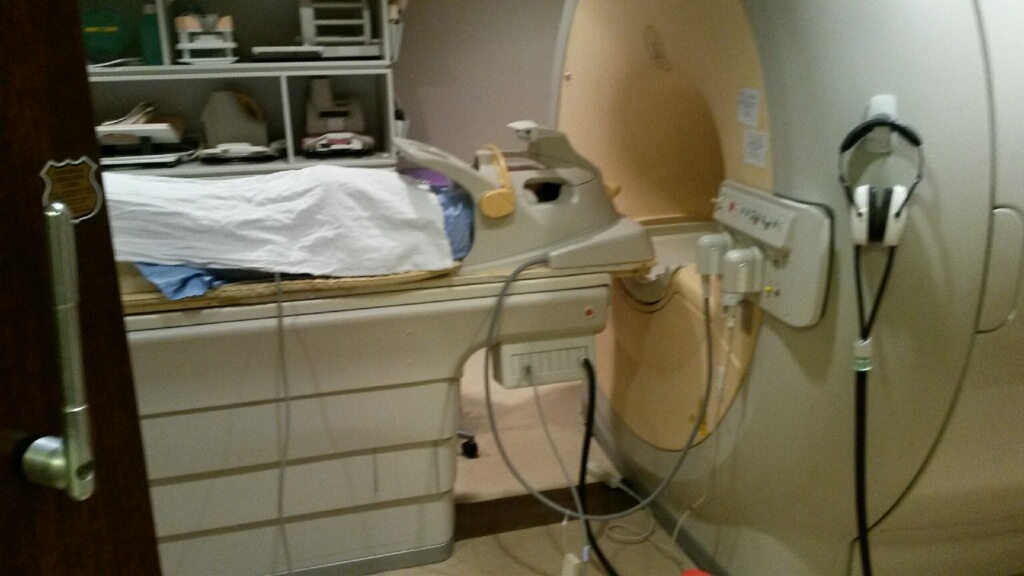
All dressed up and no place to go.

Richard adds pads to each side of my head until I’m immobilized. The plastic grate comes down over my face. I think of Hannibal Lecter and Darth Vader even though awkward football player is more apt. I am handed my panic button, a small bulb on the end of a rubber tube to squeeze if I freak out. I wiggle a little to make sure I’m as snug as I can be given the circumstances. “What sort of music would you like?” Classical. “Is one blanket enough?” Yep. Let’s do this.

I slide into the machine with my eyes open. There is a mirror above my head that allows me to see into the control room where the techs sit. I can also see my toes wiggle, which helps orient me. The plastic wall of the machine is maybe six inches above me. It’s snug. If you suspect it might freak you out, for heaven’s sake, tell them you’re claustrophobic and take the drugs. My current drug-free tactic is the early morning appointment; my natural grogginess allows me to zone out, sort of like hitting the snooze bar repeatedly if your alarm were relentless patterns of eardrum-shattering sounds. Like that car alarm that cycles through a series of uniquely annoying noises but in a lower register. Classical music is piped into the room, then stops when Richard speaks to me through the PA system: “We’ll start with some tests, okay?” Sure! Ahnt-anht-anht-anht-chukka-chukka-chukka. It begins.

My godmother used to make up songs to the sounds of her MRIs, which I think is adorable but never worked for me. In the early days when I had to spend longer in the tube and had yet to discover the glory of the morning appointment, I used to do show choir routines in my head. Scans tend to last three to eight minutes, and trying to remember choreography to a Cole Porter medley I learned in 1992 was a great way to distract myself until the next break when I could wiggle, cough, and scratch my nose.

Four scans in, it’s halftime. I slide back out into the open air. A syringe is screwed into the catheter in my right arm, and the contrast is injected. The catheter is removed. Gauze is taped to the injection site. My arm is replaced under the blanket. I slide back in. Rinse and repeat.

An hour has passed when I emerge for good, bleary-eyed and eager to sit up. I am encouraged to exercise caution and do so. I hand over my earplugs, accept an arm, and head back to the dressing room to put on my well-person drag and face the rest of the day. Before I leave, I am handed a DVD containing images from the morning’s scans plus the ones from the fall for comparison. I’m going on three years without significant new lesions and hope that trend continues.

Before returning to the office, I treat myself to a bacon and egg sandwich in the same crappy little cafe where I processed my diagnosis 13 years ago. No Camels this time.    

Totally Not Defying Gravity: In Which We Learn About Life from the Perspective of the Fallen

I fall down. A lot. As you can read here, there are many reasons why people with MS have trouble walking. Me, I experience foot drop on my left side, which causes me to trip over my own feet. My balance isn’t great, nor is my energy. All of that plus a habit of moving too fast and pushing too hard means plenty of falling.

Usually it’s a simple toe-caught-on-the-uneven sidewalk sort of thing. Or maybe a changed-directions-too-quickly-at-home collapse. Or a it’s-3am-and-I-forgot-our-bedroom-has a-step-in-it spill. (Yes, our bedroom has a step in it. I know, I know.) Whenever/wherever/however I fall, my first thought is always the quickest of body scans before my mind races to witnesses and how to appease them. I spend significantly more time worrying about ensuring that those around me are okay with what has happened and minimizing their embarrassment than I do about my own welfare. Maybe it’s a lady thing. Maybe it’s a Rebecca thing. It’s just what I do.
Tuesday morning I walked cautiously into the building where I work. It’s been rainy in DC lately, so the entry has multiple mats to keep things from getting too slick. I learned from a few near misses that the floor around the mats is extremely slippery, so I have been very careful about keeping my cane on the mat. Once I clear a foot or so beyond the mats it’s usually smooth sailing. Usually. On the day in question the humidity made my sexy MS-friendly rubber soled shoes and the floor awfully friendly, so one foot stuck while the other kept going. The fall was a double fake out. As I pinwheeled one arm and tried to get purchase with my cane with the other, it felt like I’d be okay. Nope. Alright, the wall is right here, surely I can brace myself against . . . nope. As I spun around, one shoulder and hip hit the wall, and I slid to the floor.
My employer occupies only 1 ½ floors of the eight story building where I spend 42.5 hours a week, so, for better and worse, I fell at the feet of two strangers in suits (one had a tie with multi-colored frogs on it – ah, the details one absorbs as the adrenaline settles). I can only imagine what went through their minds as a lovely but completely out-of-control woman came flailing at them at 9:10 in the morning. They were kind enough of ask if I was okay, reaching out hands to help me up. People always want to pull me back up immediately after a fall as if I’m a toddler whose tears can be prevented by a quick upsa-daisy! Grown-ass ladies with MS don’t work that way. We need a minute.
So I smiled at the nice men. I explained that I’d need some time to recover. I thanked them for their help. I apologized for startling them. After multiple reassurances, they went on their way. Bless the building concierge, who called down “You okay, Rebecca? You need a minute?” and then let me be. I sat, teary-eyed but not crying, for a full minute before hoisting myself up and facing the rest of my day.
So what can I tell you about falls from the perspective of the fallen?
  1. They’re embarrassing. It is embarrassing to lose control of your body in public. Or even at home! I know I am killing Neal slowly with every fall he witnesses. At home, even before I’m sure it’s true, I shout, “I’m okay!” upon hitting the ground in hopes of preventing the heart attack I am sure to give him eventually.   
  2. Offers of help are appreciated, but please don’t overdo it. If I’m sitting up, speaking coherently, and not bleeding, I will allow one “Are you okay?” followed by one “Are you sure?” After that, you’re just exacerbating my embarrassment by making me explain that this happens all the time, etc.
  3. Tugging someone who has just fallen up to a standing posture might be a bad idea. I’m unsteady in the best of circumstances; please don’t try to put me on my feet immediately after I have proven I cannot handle that responsibility. On a related note, when helping someone off the ground, lifting via an elbow (or armpit, if you know the person well enough) feels much more secure to the liftee than pulling by the hands. I suspect physics has something to do with this.

If you’ve spent time with me in person in the last eight years, chances are very good that I have scared. the bejesus out of you by a) tripping and catching myself, b) tripping and nearly pulling you down with me while catching myself, and/or c) hitting the ground with you nearby. Thank you for continuing to spend time with the disaster waiting to happen that is me. Please enjoy this slapped together playlist of songs about falling as a token of my gratitude.

    Diagnosis, Part Two (Electric Boogaloo): In Which a Diagnosis *Is* Given (Spoiler: It’s MS!)


    Special thanks to archivist David Wise for providing me with the primary source material at the end of this post. 
    The months between my initial appointment with Dr. Van Damme and my diagnosis on April 23, 2004 are largely a blur. I believe I left his cramped, speculum-filled office with a referral to the cleverly-named Neurology Center, conveniently located on the 2100 block of K Street, where I worked. I was assigned to Dr. Wei, an unassuming gentleman who introduced me to the battery of neurological exams I have participated in biannually since then like some sort of frequent, unathletic Olympics. Touch your nose – touch this pen. Does this feel sharp? Stand on one foot (they don’t ask me to do that anymore). Push up with your elbows; don’t let me push down. What number do you see?
    He also performed a very simple test – running a blunt, pointed instrument along the bottom of my foot – that I later learned was a sign that something was wrong with my central nervous system. Most people’s toes curl when this is done. My toes flex, making me Babinski positive.
    Dr. Wei mentioned MS as a possibility but not the onlypossibility. I could have a vitamin B-12 deficiency! Or maybe something else? More testing was necessary – starting with MRIs of my brain, cervical spine (neck), and spine. I faced the MRI with dread. I didn’t ask for drugs since I’m not technically claustrophobic, and I was mostly a brave little toaster. Still, it was tough. Lying still for so long with all of that noise is never fun. Still the worst part for me is the changing room transformation. I have had a lot of MRIs in the past 13 years, and even if I go into the radiology center feeling great and looking fierce, the moment I put on that hospital gown and look in the mirror I feel like a sick person. I remember trying on the “I have a chronic illness” persona that day and finding it drab and ill-fitting. I’m pretty sure I made it through both MRI appointments – they’ll only allow you to spend so much time in the tube on a single day – without tears on site, but I’m positive I began crying the moment Neal picked me up and didn’t stop until we got home.
    Dr. Wei brought me back in to review the results. There were lesions on my brain and spine that could mean MS, but he wanted to do more tests. In my frenzied reading I had learned that a spinal tap was sometimes called for and was beyond relieved to be spared that ordeal. Instead I was sent for two evoked response tests, which involved sticking a bunch of electrodes to my head. Once that was done, I watched a screen with a moving checkboard pattern on it, then wore headphones and listened to tones. Barring the mussing of my hair, these tests are the most pleasant (and trippiest) I’ve experienced.
    Then came the waiting. It could have been as little as a week between the final tests and my second follow up, but it felt like YEARS. I still wasn’t sleeping great due to the arm pins and needles; add worries on top of that, and I was a mess. I read lots of articles online about MS, freaked out about what it meant for my long term future but especially the short term, which was certain to be filled with needles. NEEDLES I’D HAVE TO STICK INTO MYSELF! I talked endlessly about it to my nearest and dearest. I remember my father’s trying to encourage me with tales of the Scotts’ less dramatic neurological issues – “I bet there would be plenty of spots on my brain MRI!” he said.
    Diagnosis day arrived, and I received the anticipated news. Anticipation did not soften the blow. I nodded numbly as I was told that MS was tough to diagnose with certainty but all signs pointed that way. I took the MS Society brochures I was given, as well as packets about my three injectable treatment options. Yes, I understood I should read them over and call when I’d made my choice. Thank you, Dr. Wei.
    I went downstairs to the café on the main floor of the office building, bought a 20oz Coke, and sat on the patio, crying and smoking the Camel Lights I carried then for my ever-more-frequent moments of crisis. This was before I had a cell phone, so it was just me, my grief, and two delicious vices for my first minutes as a person with MS. After a couple of cigarettes, I wiped my eyes and went down the block to my awful job to tell my boss what happened and that I would be leaving for the day. First I wrote the following to nine friends and my immediate family:

            From:      “Rebecca L. Scott” <rebecca_scott@netzero.com>
    Sent:      Friday, April 23, 2004 10:21 AM

    Subject:   results

    Hello all,

    If you’re receiving this message, then you are amongstthose who have been burdened with the knowledge of my recent medicaladventures. Although I will not likelyleave limbo completely for a while yet, this morningI did receivea “probable MS”diagnosis. Because it’s not the sort of diseaseyou can just do a blood test for, probable is about as certainas it gets in these earlystages.

    I’m still processing everything, of course. The next step will be to take a look at the drug options my doctor gave me (for those of you who are medicallyinclined, I’ll give you the nameslater). They’reall in injectionform, which means I get to learn how to administer them to myself a daunting prospect but I’m sure I’ll cope. Once I pick a drug, they’llsend me a nurse to teach me what to do.

    So that’s where we are. While I would’vepreferred to hear, “Youhave a B-12 deficiency,” I definitely feel better having a diagnosis even if it isn’t an especially pleasant one. Many thanks to all of you for your concern, offers of help, etc. It makes it a hell of a lot easierto bear knowingso many peopleare pulling for me.

    I should get back to work so I can get out of here. I’m a littletoo teary to be usefultoday. Oh, one quick lighthearted note before I go my boss hugged me and said he thinks of me like a daughter. The hug was terrifying and followedby an awkward sort of touslinggesture. And given my knowledge of his daughters, I’m not sure being thought of as one is a compliment.

    fondly,

     Rebecca

    Pity Party: In Which A Children’s Book Provides a Valuable Lesson

    Something awful happened at work today. I have already blogged about its horrors (and, wow, are they horrible), so there’s no need to rehash. I kept my shit together (*rim shot*) enough to gather my things and uber home. Once there I threw myself a pity party featuring a long bath with a fancy Australian sachet I’ve been saving for nearly a year, two Cokes, and a lot of ugly crying to This Is Us, which is ridiculously emotionally manipulative and just what the doctor ordered today.

    It’s been ages since this sort of thing happened to me, and I’m shaken. I’m also tired, angry, and frustrated. But I’m going to do my core workout, make dinner, and remember the message of Lily’s Purple Plastic Purse.

    Today was a difficult day. Tomorrow will be better.

    I’m an Asshole, Too: In Which I Nibble On Some Crow

    I recently found myself in the elevator with someone high up in the organization I work for. We don’t know each other, but we’ve exchanged pleasantries before. A hello, how are you, nice weather — office chat. That day was different, though, because he had a large, complicated sling with a padded wedge holding his arm at a specific angle off of his body. I felt it required acknowledgement but didn’t want to be so bold as to ask what happened. So what did I say?

    “Well, that’s a bold new accessory!”

    And as I did so, I realized I’m an asshole, too.

    I don’t think I offended this gentleman or that I was out of line. I definitely was participating in the sort of jokey, vague comment that I complained about in my last post, though.

    I try to greet the awkward/repeated comments of strangers/acquaintances regarding my scooter in the spirit in which they’re offered — a way of acknowledging my situation through friendly small talk. Within 24 hours of my last post a security guard said “I like your Mercedes!” and I replied with a breezy “Just three payments to go!” That’s harder to do when someone makes the same “I wanna go for a joy ride!” joke week after week, but perhaps I should try.

    ***

    And while I have feathers in my mouth . . . 

    Hidden disabilities are real and should be respected. It’s been ages since my disability was hidden. I bought a cane in 2010 for extra MS Walk support and have been using one regularly for the last six or so years. People might wonder what my disability is, but no one seeing me navigate even a short hallway on foot would mistake me for able-bodied. Lots of people with MS wear it more subtly than I. And while they may be able to cross a room gracefully, they also may suffer from terrible fatigue, pain, or a host of other issues that make handicap bathrooms and parking spaces helpful.

    Outside of the MS world, there are many conditions from chronic fatigue syndrome to Fibromyalgia to bum knees that may require special accommodations. I am pretty quick to give the side eye to someone who uses handicapped facilities that isn’t up to my standard of perceived need. I’m a Judgy McJudgerson (on many more issues than just this), and it’s not one of my best qualities.

    Bottom line? We should all try to be a little kinder and acknowledge that there is suffering that we cannot see.

    (That said, I’m pretty sure Daily Toothbrusher just likes her privacy.)

    ***

    And, finally, a wee bit of vindication.
    This is what happens when a handicap entrance button is overused.

    Oh Shit: In Which We Learn That Fecal Incontinence Will Not Kill You (No Matter How You May Wish for Death’s Sweet Release in the Moment)

    As many of you know, Neal and I used to run a trivia night on Capitol Hill. Its original incarnation was at the Pour House, a Pittsburgh-themed bar that was a very doable half mile walk from our home. A dear friend was in town visiting, and I was thrilled to share my local celebrity status with her (oh how they used to cheer when Neal said, “Helping me, as always, is the lovely and talented Score Babe, Rebecca!”). We delighted our guest with music selections and trivia tailored to her interests. The three of us stuck around for an extra round of Yuengling after the game was done. A good time was had by all.

    Initially.

    There were blessings to count. 1) I was with two people who had proven their unconditional love for me many times over and would be nothing but kind about the incident for years to come. 2) No one else was around. 3)  We were a short walk away from a hot bath and a change of clothes.

    There is no need to go into detail about the physical horrors of the experience. We are all familiar with excrement and its qualities. I hope you are not and never will be familiar with being an adult who has lost control of her bowels in a public place. For all of the physical unpleasantness, the mental toll is much, much worse. When the last, increasingly uncomfortable steps brought us to the house, I rushed straight to our downstairs half bath, locked myself in, and sobbed uncontrollably. Was this my life now? Was I going to live in constant fear of the next pants-shitting? Would I need to limit my diet to cheese and other binding agents to ensure this never, ever happened again?*

    Pajamas were brought from upstairs; soiled clothes were bagged and put in the trash outside. My sweet husband was convinced we could save the jeans, but I was having none of it. My well-meaning house guest told me about the time the same thing happened to her when she was younger and had the stomach flu. In spite of the impulse to do so, I did not scream, “STOMACH FLU DOESN’T COUNT!!!” I was too demoralized to do much but sniffle and nod. When I eventually shared my experience with other close friends, they too were empathetic and a little tone deaf, sharing stories of drunken GI mishaps. Didn’t they understand? A drunk college kid shitting their pants is hilarious. A moderately tipsy young woman doing so is tragic.

    The bad news: incontinence has visited me multiple times since that Tuesday a decade ago, and it sucks every time. The good news: I have a great gastroenterologist with a sense of humor, which is even more valuable  than a funny name. He taught me about Runner’s Diarrhea (apparently it’s not just for runners anymore!) and strategies for avoiding such embarrassments. While I’m not sure that this particular hardship that hasn’t killed me has made me stronger, it definitely has made me more resilient, and resilience is key to surviving chronic illness. So I’ve got that going for me.
     

    *This joke did NOT occur to me until many years later. Tragedy + time = comedy.

    Diagnosis, Part One: In Which No Diagnosis Is Given)

    Picture it: Washington, DC (or, more accurately, Arlington, VA), 2004. Neal and I are getting groceries at Shopper’s Food Warehouse for the Superbowl Party we’ll have that night. My stomach is acting funny, so I make repeated trips to their sad, stinky little bathroom. Sitting under the fluorescent light I noticed my feet were asleep. Both of them. Full pins and needles. Weird, right? But I stood up fine and walked okay, so I got on with buying avocados and chicken wings. Football snacks do not make themselves.

    janet-jackson-2004
    Wardrobes were not the only things malfunctioning that year!

    In the weeks that followed, the pins and needles persisted, subsided some, and then moved to my thighs, torso, and eventually settled in my arms and hands. Neal was a little worried, but I shrugged it off. In high school I’d had a numb-ish forearm for months that was attributed to a pinched nerve in my elbow. In 2002 I had spasms that distorted the right side of my face and were alarming to see (sorry, Neal!), but they didn’t affect my life much and also disappeared on their own. Surely this bizarre traveling carnival of mild discomfort would leave of its own accord, too.

    The arms bothered me more than my condition’s previous residences. This was in the dark days of my career, when I was an executive assistant at a government relations consulting firm, typing long, poorly written memos from my boss with whom I shared few political stances and even fewer ethical ones. My typing speed was lightning fast (thanks, college all-nighters!), but the semi-numbness made my hands clumsy. Worse, it was impossible to find a comfortable position for sleep. I self-medicated with Benadryl and other OTC sleep aids for a week or two to no avail before calling the doctor.

    Since I was 27 and invincible, I did not have a GP. I’d always been dedicated to taking care of my ladybits, but the rest of my body? Who has the time! Thus, I found myself scanning my insurance company’s listings and settling on Dr. Van Damme. Who wouldn’t go to Dr. Van Damme? (Sidenote: there are undoubtedly better ways of picking doctors, but I often go for humor. My current gynecology practice was chosen the moment I learned Dr. Rebecca Bush was a partner. If that isn’t destiny, I don’t know what is.)

    Alas, Dr. Van Damme exuded none of the strength and confidence of the movie star sharing his surname. His waiting room was dark and tiny; the exam room was a jumbled mess of papers and boxes with blunt, bold labels (the words “PLASTIC VAGINAL SPECULUMS” haunt me to this day). His bedside manner was that of an unfunny Woody Allen. He heard my tale, took my vitals, and shrugged, suggesting I see a neurologist. I left frustrated that relief wasn’t in the near future yet relieved that I’d never have to visit him again.

    Let’s Do This

    This blog exists for two reasons: to encourage me to flex my writing muscles and to share a little about what life MS is like . . . for me, at least. I’ll document fun procedures like bladder Botox injections, share some of my Strategies for Success (Neal’s coinage, which is accurate but somewhat gag-worthy), review various stores’ mobility scooters, and bitch just a little.

    A word of warning: there will be candor. If you’d rather think of me as a classy lady who’d never discuss her own bodily functions, please do not follow this blog. (Also, clearly we haven’t met.) If you can take the occasional overshare, do join me on this journey. 
    The coolest borrowed scooter ever – at Zealandia in Wellington, New Zealand.