On Squeaking: In Which I Make a Case for Relentless (But Polite) Self-Advocacy

I have not gone gentle into disability. Each assistive concession, from buying my first cane to installing grab bars in the shower, was agreed to only after heated discussion, gnashing of teeth, and tears. Neal has cajoled me into the acceptance of things that make my life better at home, and we’ll talk more about them later. Today I’ll tell you about my journey from silent sufferer to squeaky wheel at work.

When I first walked up the white marble steps of the Folger Shakespeare Library, a beautiful, old, totally not handicapped-friendly building, I was an able-bodied 28-year-old. As the years went on, those stairs became more treacherous, especially when slick with rain. There was nothing to be done about them, though, so I either walked verrrrry slowly or entered through the rear of the building on wet or weak days.

Bathrooms were a different story. I worked in the basement where a men’s room with a single stall was between my office and the two stall women’s room. Having my bladder give up between these two pit stops occurred a few times before I finally wrote something akin to the following to the HR manager.

Hi there! Among the many gifts MS has bestowed upon me is a less than reliable bladder. Having to walk all the way to the ladies’ room is sometimes a hardship, and I wonder if maybe the men’s room could be converted to unisex. Thanks for your help.


Shortly thereafter I got a reply saying that this was indeed a reasonable accommodation and that she would work on an announcement and ordering a new sign. Easy peasy.

 
A = office * B = men’s room * C = women’s room * P! = you get it
 
When I moved to government work, I foolishly assumed that the office would be accessible. The government WROTE the Americans with Disabilities Act, after all! How could they not be friendly to the plight of the less mobile?

In so very many ways.

I won’t go into the challenges of entering either of the museum buildings from a wheeled device nor the shitty signage for the ramps and elevators that do exist. Not now, at least. I work in a modern office building with (hurrah!) a button operated door to enter from the sidewalk. The concierges are wonderfully helpful (see this post for proof) and take care of calling the elevator for me. Once on the correct floor, though, the problems began. The office could be entered by two sets of beautiful, ridiculously heavy glass doors. Heavy like, throw your entire body weight into pulling it open and then quickly wedge a shoulder against it so it doesn’t close while you recover from the strain of opening it heavy. Pushing through was easier but still a challenge. The break room doors were identical with the added bonus that one would usually pass through them with hot coffee or a week’s worth of snacks in one’s hands. Even strapping middle-aged (they don’t make ’em young here, y’all) men would see me throwing myself against these doors and say, “They are awfully heavy, aren’t they?”

Then there was the issue of the bathroom. In order to reach the women’s room I had to take 82 steps, pass through one set of the aforementioned glass doors, AND get my clumsy-ass hands to fit a key into a lock, turn that key, and then remove it. Come watch me do that on my best day when I have no pressing needs, and I assure you it will not be pretty. Doing it with a straining bladder (or worse)? Tragic.

So, barely a month into the new job, I talked to someone in HR about my concerns, and within two weeks an email went out about collecting everyone’s bathroom keys. The office was abuzz with excitement about that inconvenience being removed. I gave myself a tiny internal high five for making everyone’s lives better. One issue down, one to go.
 
A month and a half passed, and in November I was told that the glass doors would be adjusted so they required no more than five pounds of force to open (the ADA standard for interior doors).
 
Shortly after Christmas, I inquired about the status and was told we were “waiting on a part.” 
 
In early March, the pantry doors were adjusted at last. There were some growing pains — near injuries thanks to people pushing/pulling too hard, which was a little hilarious to be honest — but, again, people were pleased.
 
In late April, still awaiting action on the entry doors, I reached out to the EEO coordinator to check in, saying, “I’m not the only disabled person on the floor presently – we have someone with a walking stick, someone on crutches, and two folks with slings.”

On May 19, almost eight months to the day from my initial email to the HR manager, the entry doors were adjusted. And there was much rejoicing. On my part, at least.
 
I realize this hasn’t been the most engaging post, but there is an important message. If you need help, advocate for yourself. If you’re lucky enough to have an EEO office, start there; if not, HR should be a good bet. If you’re among those not yet needy, keep your eye out for how your workplace (or any place) might be unfriendly to gimps like me and speak up if you think adjustments should be made.    
 
Squeak your ass off until necessary change finally happens.  

Luxuries of Youth: In Which My Heart Breaks for a Small Child and Yet I Envy Her

This morning I rose promptly at 7 instead of asking Alexa to perform all of her tricks — news, Jeopardy!, jokes — as I usually do to delay facing the day. I showered last night to speed my morning routine in the name of arriving at my infusion center at 8am, thus minimizing the amount of time I have to make up at the end of the day now that I am out of paid leave. #newjobproblems

I’m back to the infusion center I like. It’s a part of Arthritis and Rheumatism Associates, which ensures I think of Uncle Wiggily every four weeks. I go in, fill out a form about my abilities/sense of well-being (today I’m a six on the zero to ten/best to worst scale), and then settle in for 90 minutes of screen time and the drip, drip, drip of the drug that’s helped my disease steady for the past three and a half years.

“Uncle Wiggily wants to be cured of his rheumatism.  On the way to Dr. Possum’s office, he has many adventures.”
The Uncle Wiggily Game, © 1967 Parker Brothers

Today’s cast of patients was familiar at first — two young women receiving RA meds and an older lady in a wheelchair whose condition I was unsure of. Usually if folks take a pre-infusion dose of Benadryl, it’s a good bet that it’s RA, but some skip it. I’ve run into only two fellow MS-havers in my years of infusions. This morning brought a brand new experience. A mother and child of eight, I’m guessing, came into the infusion room together. I initially assumed that mom had brought the kid due to lack of child care, but then I noticed the sobbing. “I’m sorry. This isn’t our favorite day,” the mom told the nurses.

This girl was terrified, clutching to her face a stuffed sheep with a silky underbelly as she climbed onto the orange-y tan vinyl infusion chair next to mine. Her mom spoke quietly: Look at me. Breathe. It’s okay to be scared. You can hold my hand. There would be quiet for a moment, and then the stuttered inhale followed by a squeaky moan and nose wipe on that poor sheep. Those are the sounds of trying to be brave but knowing you’re failing. In a futile gesture toward privacy, the mom pulled the curtains I’ve never seen anyone use around the chair. A wonderful nurse came over, telling stories of other children she’s worked with, some who even learned to put in their own IVs! One was later prom queen! “I’ll make you a deal: if you stay very, very still, then I’ll be very, very quick.”

I’m an empathetic soul, so my eyes welled up on my side of the curtain. I can’t be that close to palpable fear and sadness without it creeping into me. Poor kid! I thought. I remember being terrified of blood tests! It was so hard to sit still at that age — imagine doing it knowing there’s a needle in your arm! And then my thoughts took a turn . . . Why must I wait, smiling and patient, while the nurse moves the needle in my arm, trying to hit a vein? Why can’t I sob publicly at the injustice of getting chosen in this cosmic game of Duck-Duck-Goose? Why do I have to go to work and pretend that everything is fine even on days when I am scared out of my wits that I will never be able to make a full meal without help again (more on this later), when my energy is completely sapped by heat, when I can’t seem to walk three steps without tripping?

Sometimes I just want someone to wipe away my tears and promise to take me to ice cream later.

Small Embarrassments: In Which Ice Cream-Related Disaster Is Narrowly Averted


I often whine about working in a corporate office building. After years in a beautiful library sharing an office space with two colleagues, sitting in a cubicle farm with an outward-facing monitor is a hardship. Every now and again there’s a bonus to traditional office life. Like today, when the building managers threw an ice cream social. I went downstairs at 2 to collect my share, a scoop of toffee crunch in a sugar cone cup. What a novel presentation! I gripped my cane with my left hand, holding the cone-cup as gingerly as possible as I made my way to the toppings table. One step. Two steps. Crunch! My poor motor skills caused a wobble followed by an overcompensating grasp to steady things, leading to a “Hulk smash!” moment. Half of the cone-cup crumbled to the floor as I cradled the remaining cone bits and ice cream in my hands. A colleague called for a regular bowl, but, alas, they had run out. Another colleague rushed over napkins, on which we placed a fresh cone-bowl, in which I placed my slightly mangled dessert. The ice cream lady apologized repeatedly as if she had somehow caused the near calamity. I slunk back to the toppings table for hot fudge.
None of these toppings were offered, BTW.
I live to eat and drink, but eating and drinking now comes with risk. Cutting meat at a nice dinner often results in silverware clattering down to the plate . . . or, worse, the floor. The hand-hand coordination of bread buttering is daunting. A full glass of any beverage is a hazard to all within a three foot radius. I’ll be damned if I’m going to stop eating steak or start eating my bread unbuttered, though. I suffer these small embarrassments with a polite apology and a smile and let life (and the meal) go on.

It Was the Best of Times, It Was the Worst of Times: In Which We Begin a Series of Posts on the of the Joy and Heartbreak of Concert-Going with a Disability (1 of ?)

Neal and I have always enjoyed live music, but we have stepped up our concert game recently to make up for the fact that we aren’t vacationing this summer. This is the first in a series of posts about our live music adventures.
FedEx Field – After much deliberation, Neal decided that he could not let longtime favorite U2 come to the DMV (playing The Joshua Tree, no less) without being there. Being a dutiful wife, I agreed to join him. My only other visit to FedEx Field was for a football game back when I was able-bodied enough to walk into the stadium, and still the press of drunken fans and ensuing chaos then left me in tears. You’d think that would prepare me for the ordeal to come. (Spoiler: it did not.)
Everything about FedEx Field is a hassle starting with figuring out how/where to park. After several false starts, we were waved into the main lot and ended up quite close to the stadium. The entrance for folks on wheels was not one of the four closest entrances, however, and we had to ask three people before getting a certain answer about where to go. Once we got our elevator pass wrist bands and entered a lift, I foolishly breathed a sigh of relief.
FedEx Field does not allow its patrons to buy accessible seating ahead of time. The Washington football team’s website states:
Please note that accessible seating and parking is limited, so please arrive early to ensure availability. . . Accessible seating is available on all levels at FedExField. Fans in need of accessible seating should visit Guest Services, located on every level inside the stadium at Gates A and E, on the day of the game.
So, if like Neal and me, you have full time jobs and are thwarted by traffic, causing you to arrive as the Lumineers are Hey-Ho-ing their way through the opening act, you may be SOL. We kept our chins up, though, and found our way to the Guest Services line, which had about eight people in groups of two or three ahead of us. There was one wheelchair-bound guest in line with us, as well as a gentleman on a knee scooter, but mostly it was drunk, angry men in ill-fitting polo shirts taking up the time of the three stadium employees at the window, only one of which had access to a device capable of seat searching and ticket printing. So we stood/sat (I was in my wheelchair) as patiently as possible, neither kicking nor shouting at the numerous assholes that, in their hurry to get to the beer kiosk, stepped over my feet without so much as an excuse me. 30 minutes passed without any progress being made. A drunk bro from the back of the line pushed past us and was met with polite objections. “I’m not cutting! I’m going to yell at these people!” he replied. When I pointed out that yelling was not going to get us through the line any faster, he said, “What, are you just going to do nothing?!” Neal, my hero, said, “Sir I understand you’re upset, but I hope you aren’t yelling at my wife,” and the bro retreated.
After an apparent eternity, we reached the front of the line and were given two seats on an upper level. Before going there, we took advantage of the handicapped-only bathrooms nearby, both of which had lines of able-but-lazy-bodies outside. A sweet smile got me to the front of the line.
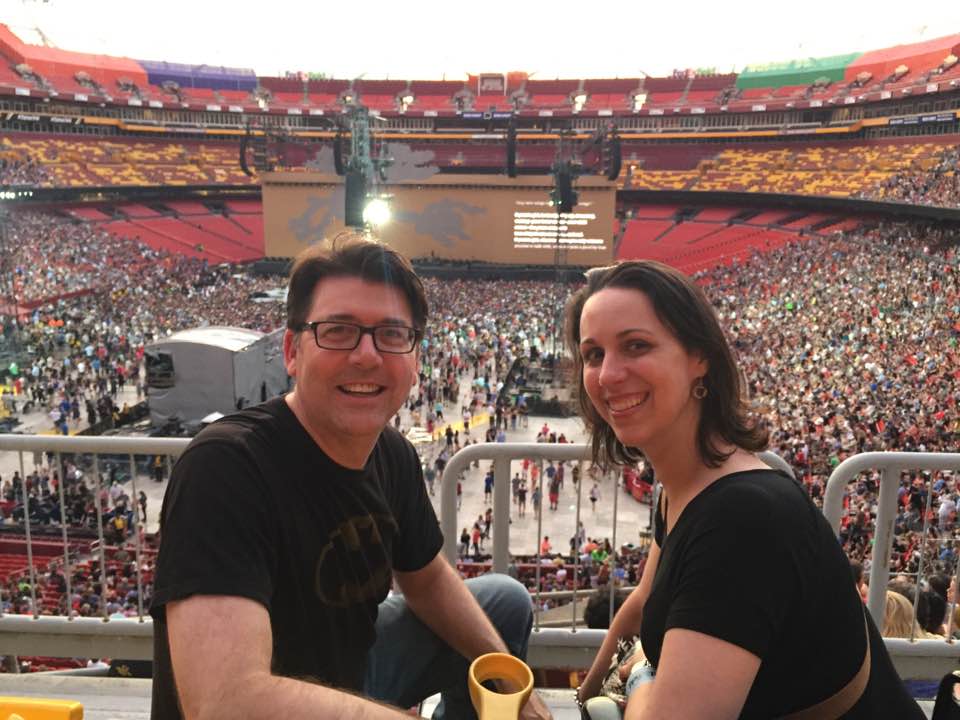
With empty bladders and tickets in hand, we felt newly optimistic. Another elevator took us up a level, and, with a little assistance from the inept but well-meaning FedEx ushers, we found our newly-assigned section . . . which could only be reached via stairs. We returned to the ushers, who pulled a frazzled, fresh faced ginger from Guest Services. He was all apologies as he grabbed our tickets and jogged back to his computer. He returned within 10 minutes with handwritten tickets. “This is the last accessible seat in the house. If someone else is there, please come get me.” We proceeded to our new new seats, and – glory hallelujah! – found an open spot for a wheelchair as well as an empty seat next to it. A huge sigh of relief was breathed. A beer was procured. The moment was documented (see below). The concert began!
And then three tipsy ladies showed up, puzzled that Neal was occupying one of their seats. He got up, but they remained distressed, clearly upset that they had separated this nice man from his wheelchair-bound companion. One leaned in, shouting, “Is your boyfriend okay?!” I proceeded to type a reassuring message on my phone about the situation and held it up to the face of the woman closest to me. She seemed to relax. 
It was less than ideal to enjoy a concert with Neal standing behind me, but our “seats” were outstanding and I think he enjoyed having room to dance. The ladies next to us were adorable hot messes (the audience was full of sloppy drunks — I guess folks are out of practice in middle age), all of whom wanted to know my name, hug me, and say how much they enjoyed sitting by me. This is a weird side effect of the wheelchair: people get extra friendly in a way that borders on patronizing. I try to take it in the spirit in which it’s offered.
Was it worth the hassle to see a legendary band? I’m unconvinced, but the concert made Neal awfully happy — and it was nice to share that with him (albeit through the occasional shoulder touch and backwards glance). I am done with FedEx Field, though. Until the End of the World.

A Sort of Storyteller: In Which My Body Mixes Things Up Further (2 of 2)


Shortly after my tiny goiter was rediscovered, I went to the gynecologist for my annual ladybits check. A week later, Dr. Safran called to say that my pap smear had come back abnormal, which wasn’t necessarily cause for alarm. Because it was my second abnormal smear in as many years, he wanted to take a closer look. Literally. So we scheduled a colposcopy, which is essentially an extra invasive and aggressive pap smear involving a speculum, a specialized microscope, a vinegar solution (I shit you not), and a biopsy instrument. The vinegar helps “highlight areas of suspicious cells” (thanks Mayo Clinic), which are then sampled and sent off to the lab. Pre-procedure, the mild-mannered Dr. Safran sighed and said, “I’m sorry. Everything I do is so uncomfortable.” “For you or for me?!” I asked, knowing the answer. The procedure itself was indeed uncomfortable, as was recovery. The worst of it was having something orange-ish, papery, and alien emerge from my body a couple of days afterward. I panicked then did what any sensible modern woman would do – took a photo and emailed it to my doctor, who calmly replied, “Oh, that’s just the material we use to staunch the bleeding.” Oh. Is that all?
HOW DO YOU NOT WARN A PERSON WHEN STUFFING STRANGELY COLORED THINGS INTO HER PARTS?! HOW?!
In less than a week, Dr. Safran called to tell me the samples exhibited moderate dysplasia, which is abnormal, possible pre-cancerous growth. Ack! The “pre” was comforting, but “cancerous?!” No one wants to hear that. Dr. Safran said we could either cut out the offending bits or go for a full hysterectomy given my age (ack again!) and history of fibroids. I spent a week or so weighing the options and discovering that multiple friends had undergone a LEEP (Loop Electrosurgical Excision Procedure) with great success. Much as bidding adieu to tampons forever appealed, I ultimately decided to decline major surgery.
I met with the surgeon, Dr. O’Brien, who looked Doogie Howser young on first glance – this is a tough thing about getting older; I constantly feel as if I’m living in one of those adorable commercials where small children are dressed as doctors, lawyers, etc. My latent ageism aside, Dr. O’Brien clearly knew her stuff and agreed that the simpler procedure was best. We scheduled an appointment in early June. I asked work for the recommended three days off for recovery.
While doctor O’Brien’s youth was alarming, I did appreciate her sparkly shoes.
The surgery was scheduled for 8:30am, which meant a 6:30 arrival and a 5:30 wake up call. I was instructed not to apply any lotions or make up to my body. At 5:30, I’m lucky to apply clothes to my body successfully, so this was not a hardship. Neal and I drove across town to the tony Sibley hospital, and, my heavens, I get what the fuss is about! Sure, navigating the place was a pain in the ass, but being seated in a quiet, well-appointed waiting room where the only screens silently announce patient progress and the magazines are interesting (and current!) was a treat. We checked in at the desk, handing over my advance directive along with the other paperwork. Logically I knew major complications from minor ladybit surgery were unlikely, but I hadn’t had major sedation since I got my wisdom teeth out in ’91 and was a little freaked out.
Eventually we were taken to prep, where I changed into a hospital gown and the coziest free safety socks I’ve ever been given. I was informed that I was welcome to change the channel on the TV in the room but was comforted by the steady stream of relaxing nature images it already delivered (butterflies were an obvious choice, moose less so). I was seen by a stream of charming nurses, all of whom seemed to ask the same questions. My favorite of the bunch asked about pain. I replied, “Well, I have a minor headache, but that’s likely due to not eating or drinking anything this morning.” She smiled, looked at Neal, and said, “Isn’t she pleasant?! She is so pleasant!” Then she looked at me to say, “The way you responded – it’s like you’re a sort of storyteller.” I shudder to think of the BS medical professionals must have to deal with that makes my bleary-eyed banter delightful by comparison.
I was hooked up to an IV. The forgettable anesthesiologist popped by to say hi. I was given a very sexy hairnet. It was showtime.
The operating room was bright and shiny and felt like overkill for such a simple procedure. I recall thinking everyone in the space was delightful as we chatted about how great the first appointment of the day is. I also was sliding into lala land, so it’s entirely possible they were all jerks. I think I made it through two breaths in the mask before conking out.
When I awoke I was thrilled not to be dead and annoyed not to still be sleeping (as a friend who recently had surgery said to me afterward, “You see why Michael Jackson got hooked on that stuff!”). I perked up when I was brought ginger ale and crackers. Neal joined me. When deemed suitably stable and awake I got dressed and went home for three days’ rest.
 
Last week I visited Dr. O’Brien, who informed me that the cells were indeed CIN2, the margins were clear, and my cervix looks healthy. Crisis averted. Another medical adventure logged.     

The Best Kind of Patient: In Which My Body Decides to Mix Things Up (1 of 2)

When first diagnosed with MS, I comforted myself with thoughts like “At least it isn’t cancer!” So I tucked my hypochondria away into a memory box, certain I wouldn’t need it now that I’d been assigned my disease. Then the MS Society’s mediocrely written but informative magazine, Momentum, showed up on my doorstep with headlines like “MS and . . . Managing Two Chronic Illnesses.” Say what?! What kind of a bullshit world do we live in? One that can dole out multiple heavy physical burdens at once, it seems. I’m pleased to report that presently I’m holding steady with a single illness, but I have just wrapped up ten weeks of queries, biopsies, and procedures confirming that.

I saw my GP at end of March. She noticed, as she* did six years ago, a lump on my thyroid. This prompted an ultrasound, which showed the lump had grown one centimeter. Thus it was time for a needle biopsy (AKA fine needle aspiration or FNA). What fun! I had done this dance back in 2011, so I was reasonably calm about it — both in terms of the likelihood that everything was benign and the anticipated discomfort. As I emailed to my family after the first go round, “The local anesthesia burned like crazy, but it meant the extractions were painless.”

Imagine my delight when the pathologist entered the 10’x10′ biopsy room and said, “We don’t bother with anesthesia anymore. It often creates a lump that makes the biopsy more difficult.” Cool cool cool. I can do this. The doctor, a fellow, and a guy doing a swap from NIH** crowded around the exam table. NIH held a tiny cold pack to my neck, the fellow looked on, and the doctor prepared the needle, talking about how thin my neck is. Thin neck = tiny needles. Win. The lack of anesthesia meant each needle hurt, but each stick was fairly quick and burn-free. After the third aspiration, the anticipated question came, “Would you mind if the fellow did the next one?” I said, “That’s fine! I know whenever I’m at a teaching hospital getting poked by amateurs part of the deal. Plus, I think it’s important.” Did I sound like a kiss-ass? Sure! But I meant it. “Oh, I was going to wait until the end of this to tell you, but I’m going to say it now — you are the best patient! You’re so easy-going.”

It took five sticks in all. Unsurprisingly the fellow’s was the clumsiest of the lot, but he made a noble effort. After each sample, the pathologist put some cells on a slide, stained them, and took a look to make sure she was getting what she needed. Before I left, my AP bio instincts kicked in, and, emboldened by my status as “the best patient,” I asked to look in the microscope. The pathologist gave me a brief tour of the cells on the slide, pointing out signs that my growth (which, fun fact, is technically a freaking goiter) was merely inflammation and nothing malignant.

A week later my GP called to confirm just that, so I guess I’m off the hook thyroid-wise . . . for another six years.

*My GYN was the first to notice the lump. When I told a friend, she laughed and said, “Through your pap smear?!” I have the best squad.

** All of my caregivers were different nationalities, which seemed ripe for a joke (“an Indian, a Pakistani, and a Russian walk into an exam room”), but, alas I couldn’t muster it. Also, that’s racist.

“Everyone has a favorite!” says this panda, my biopsy companion.
I realize this an odd accompanying photo, but the other option was a goiter. No one wants to see that.

Lie Back and Think of England . . . Or Show Choir: In Which We Learn How to Survive An MRI

If my alarm goes off before 7am, there must be a damn good reason for it, preferably one that has something to do with traveling somewhere fun to eat wonderful things. In the case of last Tuesday, I rose at 6:08 to travel five miles across town for a brain MRI. Hardly fun or wonderful but a necessary twice-a-year ritual thanks to my current disease modifier, Tysabri.

Tuesday’s was my thirteenth MRI since 2010! (Hat tip to Google Calendar for that statistic.) I bet if you added up all of my MRIs since 2004, you’d find that I had logged a full day in the tube. It isn’t quite enough to fulfill Malcolm Gladwell’s 10,000 hour rule, but I daresay I’m pretty good at it.

MRIs begin with extensive questionnaires about the metal in your body. It is wise to take these questions seriously, because the M stands for Magnet(ic) — and you do *not* want to forget to mention (and remove!) a nipple ring before encountering a super strong magnet. (I was once in the waiting room with a mother and teenage daughter; the latter had *just* gotten an eyebrow ring and much drama ensued.) If your procedure involves contrast, as mine always does, there are also multiple forms to sign about understanding the risks, which are minimal for folks with normal kidneys.

Since I’m only wanted for my brain (sigh, just like high school), I get to keep my pants on (see previous parenthetical), removing my belt and wearing only a hospital gown on top. I addressed the toll gowns can take on your psyche in Diagnosis Part Two. If you’re a lady or a confident man, I highly recommend going for a pink gown if the option is offered. Pink will perk a person right up. Sadly, I was stuck in drab blue this time around. The dressing rooms at my MRI center are much like the dressing rooms at any department store, except instead of a door each enclosure has a curtain. This makes clothes changing the most stressful part of the procedure for me, since the only thing between me and falling into the hallway, bra akimbo, is fabric and my questionable core strength. My most recent visit was a success in the not-flashing-the-techs realm.

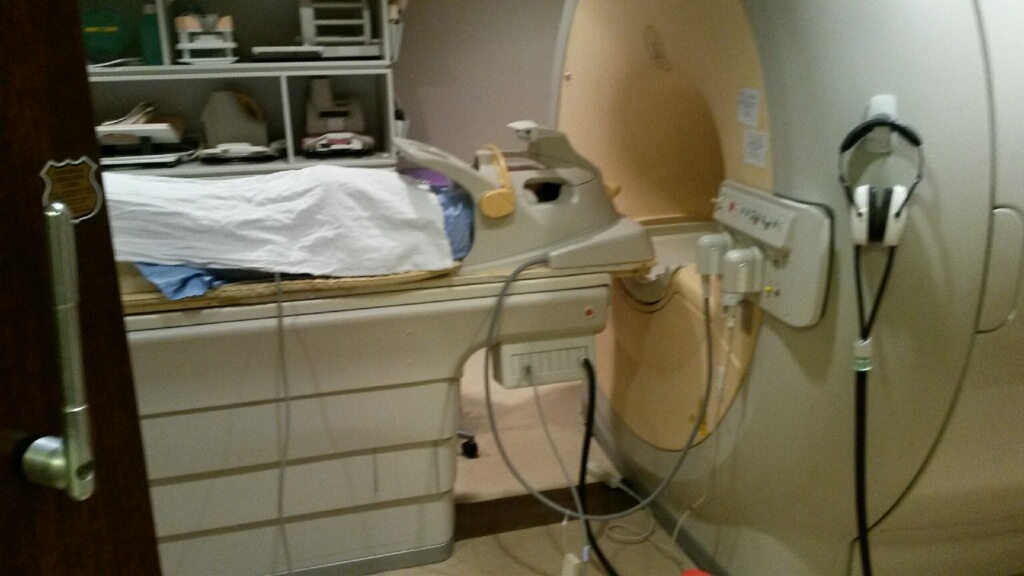
All 20+ MRIs I’ve gotten have been at the same place. The welcome I receive isn’t quite an enthusiastic, Cheers-worthy “Rebecca!” but it is warm and familiar (so much so that when I express dismay at having forgotten to bring phone for a photo for this very blog, the tech offers to use his phone and text me). Richard, who has been my tech on many occasions, fetches me from my dressing area with a new guy named Sergei, Richard kindly offering his arm. We cross the hall together, and I hop on the table without being told, making sure the wedge pillow that supports my legs is at just the right angle. MRIs’ accuracy depends on stillness, and comfort is key to stillness. If you twitch, there may need to be do-overs. Do-overs mean more time in the tube. No one wants that.

Knee pillow in place, I accept earplugs and lie back gingerly to place my head in its plastic enclosure. Richard offers a blanket, which I accept. (Comfort! And modesty! I’m braless in a chilly space — you can do the math.) I am asked an arm preference and offer up my left, which Sergei tries, unsuccessfully, to find a good vein in. It’s not contrast time yet, but they like to have everything ready so that they can simply inject the agent at halftime. My right arm is more cooperative. Saline is injected, and Richard says his usual spiel: “You may get a weird taste in your mouth or smell an unpleasant smell.” The smell is like rubbing alcohol, and I am always amazed and delighted that an injection can inspire the sensation of scent. Much about *my* body sucks, but bodies in general are cool!

All dressed up and no place to go.

Richard adds pads to each side of my head until I’m immobilized. The plastic grate comes down over my face. I think of Hannibal Lecter and Darth Vader even though awkward football player is more apt. I am handed my panic button, a small bulb on the end of a rubber tube to squeeze if I freak out. I wiggle a little to make sure I’m as snug as I can be given the circumstances. “What sort of music would you like?” Classical. “Is one blanket enough?” Yep. Let’s do this.

I slide into the machine with my eyes open. There is a mirror above my head that allows me to see into the control room where the techs sit. I can also see my toes wiggle, which helps orient me. The plastic wall of the machine is maybe six inches above me. It’s snug. If you suspect it might freak you out, for heaven’s sake, tell them you’re claustrophobic and take the drugs. My current drug-free tactic is the early morning appointment; my natural grogginess allows me to zone out, sort of like hitting the snooze bar repeatedly if your alarm were relentless patterns of eardrum-shattering sounds. Like that car alarm that cycles through a series of uniquely annoying noises but in a lower register. Classical music is piped into the room, then stops when Richard speaks to me through the PA system: “We’ll start with some tests, okay?” Sure! Ahnt-anht-anht-anht-chukka-chukka-chukka. It begins.

My godmother used to make up songs to the sounds of her MRIs, which I think is adorable but never worked for me. In the early days when I had to spend longer in the tube and had yet to discover the glory of the morning appointment, I used to do show choir routines in my head. Scans tend to last three to eight minutes, and trying to remember choreography to a Cole Porter medley I learned in 1992 was a great way to distract myself until the next break when I could wiggle, cough, and scratch my nose.

Four scans in, it’s halftime. I slide back out into the open air. A syringe is screwed into the catheter in my right arm, and the contrast is injected. The catheter is removed. Gauze is taped to the injection site. My arm is replaced under the blanket. I slide back in. Rinse and repeat.

An hour has passed when I emerge for good, bleary-eyed and eager to sit up. I am encouraged to exercise caution and do so. I hand over my earplugs, accept an arm, and head back to the dressing room to put on my well-person drag and face the rest of the day. Before I leave, I am handed a DVD containing images from the morning’s scans plus the ones from the fall for comparison. I’m going on three years without significant new lesions and hope that trend continues.

Before returning to the office, I treat myself to a bacon and egg sandwich in the same crappy little cafe where I processed my diagnosis 13 years ago. No Camels this time.    

Totally Not Defying Gravity: In Which We Learn About Life from the Perspective of the Fallen

I fall down. A lot. As you can read here, there are many reasons why people with MS have trouble walking. Me, I experience foot drop on my left side, which causes me to trip over my own feet. My balance isn’t great, nor is my energy. All of that plus a habit of moving too fast and pushing too hard means plenty of falling.

Usually it’s a simple toe-caught-on-the-uneven sidewalk sort of thing. Or maybe a changed-directions-too-quickly-at-home collapse. Or a it’s-3am-and-I-forgot-our-bedroom-has a-step-in-it spill. (Yes, our bedroom has a step in it. I know, I know.) Whenever/wherever/however I fall, my first thought is always the quickest of body scans before my mind races to witnesses and how to appease them. I spend significantly more time worrying about ensuring that those around me are okay with what has happened and minimizing their embarrassment than I do about my own welfare. Maybe it’s a lady thing. Maybe it’s a Rebecca thing. It’s just what I do.
Tuesday morning I walked cautiously into the building where I work. It’s been rainy in DC lately, so the entry has multiple mats to keep things from getting too slick. I learned from a few near misses that the floor around the mats is extremely slippery, so I have been very careful about keeping my cane on the mat. Once I clear a foot or so beyond the mats it’s usually smooth sailing. Usually. On the day in question the humidity made my sexy MS-friendly rubber soled shoes and the floor awfully friendly, so one foot stuck while the other kept going. The fall was a double fake out. As I pinwheeled one arm and tried to get purchase with my cane with the other, it felt like I’d be okay. Nope. Alright, the wall is right here, surely I can brace myself against . . . nope. As I spun around, one shoulder and hip hit the wall, and I slid to the floor.
My employer occupies only 1 ½ floors of the eight story building where I spend 42.5 hours a week, so, for better and worse, I fell at the feet of two strangers in suits (one had a tie with multi-colored frogs on it – ah, the details one absorbs as the adrenaline settles). I can only imagine what went through their minds as a lovely but completely out-of-control woman came flailing at them at 9:10 in the morning. They were kind enough of ask if I was okay, reaching out hands to help me up. People always want to pull me back up immediately after a fall as if I’m a toddler whose tears can be prevented by a quick upsa-daisy! Grown-ass ladies with MS don’t work that way. We need a minute.
So I smiled at the nice men. I explained that I’d need some time to recover. I thanked them for their help. I apologized for startling them. After multiple reassurances, they went on their way. Bless the building concierge, who called down “You okay, Rebecca? You need a minute?” and then let me be. I sat, teary-eyed but not crying, for a full minute before hoisting myself up and facing the rest of my day.
So what can I tell you about falls from the perspective of the fallen?
  1. They’re embarrassing. It is embarrassing to lose control of your body in public. Or even at home! I know I am killing Neal slowly with every fall he witnesses. At home, even before I’m sure it’s true, I shout, “I’m okay!” upon hitting the ground in hopes of preventing the heart attack I am sure to give him eventually.   
  2. Offers of help are appreciated, but please don’t overdo it. If I’m sitting up, speaking coherently, and not bleeding, I will allow one “Are you okay?” followed by one “Are you sure?” After that, you’re just exacerbating my embarrassment by making me explain that this happens all the time, etc.
  3. Tugging someone who has just fallen up to a standing posture might be a bad idea. I’m unsteady in the best of circumstances; please don’t try to put me on my feet immediately after I have proven I cannot handle that responsibility. On a related note, when helping someone off the ground, lifting via an elbow (or armpit, if you know the person well enough) feels much more secure to the liftee than pulling by the hands. I suspect physics has something to do with this.

If you’ve spent time with me in person in the last eight years, chances are very good that I have scared. the bejesus out of you by a) tripping and catching myself, b) tripping and nearly pulling you down with me while catching myself, and/or c) hitting the ground with you nearby. Thank you for continuing to spend time with the disaster waiting to happen that is me. Please enjoy this slapped together playlist of songs about falling as a token of my gratitude.

    Diagnosis, Part Two (Electric Boogaloo): In Which a Diagnosis *Is* Given (Spoiler: It’s MS!)


    Special thanks to archivist David Wise for providing me with the primary source material at the end of this post. 
    The months between my initial appointment with Dr. Van Damme and my diagnosis on April 23, 2004 are largely a blur. I believe I left his cramped, speculum-filled office with a referral to the cleverly-named Neurology Center, conveniently located on the 2100 block of K Street, where I worked. I was assigned to Dr. Wei, an unassuming gentleman who introduced me to the battery of neurological exams I have participated in biannually since then like some sort of frequent, unathletic Olympics. Touch your nose – touch this pen. Does this feel sharp? Stand on one foot (they don’t ask me to do that anymore). Push up with your elbows; don’t let me push down. What number do you see?
    He also performed a very simple test – running a blunt, pointed instrument along the bottom of my foot – that I later learned was a sign that something was wrong with my central nervous system. Most people’s toes curl when this is done. My toes flex, making me Babinski positive.
    Dr. Wei mentioned MS as a possibility but not the onlypossibility. I could have a vitamin B-12 deficiency! Or maybe something else? More testing was necessary – starting with MRIs of my brain, cervical spine (neck), and spine. I faced the MRI with dread. I didn’t ask for drugs since I’m not technically claustrophobic, and I was mostly a brave little toaster. Still, it was tough. Lying still for so long with all of that noise is never fun. Still the worst part for me is the changing room transformation. I have had a lot of MRIs in the past 13 years, and even if I go into the radiology center feeling great and looking fierce, the moment I put on that hospital gown and look in the mirror I feel like a sick person. I remember trying on the “I have a chronic illness” persona that day and finding it drab and ill-fitting. I’m pretty sure I made it through both MRI appointments – they’ll only allow you to spend so much time in the tube on a single day – without tears on site, but I’m positive I began crying the moment Neal picked me up and didn’t stop until we got home.
    Dr. Wei brought me back in to review the results. There were lesions on my brain and spine that could mean MS, but he wanted to do more tests. In my frenzied reading I had learned that a spinal tap was sometimes called for and was beyond relieved to be spared that ordeal. Instead I was sent for two evoked response tests, which involved sticking a bunch of electrodes to my head. Once that was done, I watched a screen with a moving checkboard pattern on it, then wore headphones and listened to tones. Barring the mussing of my hair, these tests are the most pleasant (and trippiest) I’ve experienced.
    Then came the waiting. It could have been as little as a week between the final tests and my second follow up, but it felt like YEARS. I still wasn’t sleeping great due to the arm pins and needles; add worries on top of that, and I was a mess. I read lots of articles online about MS, freaked out about what it meant for my long term future but especially the short term, which was certain to be filled with needles. NEEDLES I’D HAVE TO STICK INTO MYSELF! I talked endlessly about it to my nearest and dearest. I remember my father’s trying to encourage me with tales of the Scotts’ less dramatic neurological issues – “I bet there would be plenty of spots on my brain MRI!” he said.
    Diagnosis day arrived, and I received the anticipated news. Anticipation did not soften the blow. I nodded numbly as I was told that MS was tough to diagnose with certainty but all signs pointed that way. I took the MS Society brochures I was given, as well as packets about my three injectable treatment options. Yes, I understood I should read them over and call when I’d made my choice. Thank you, Dr. Wei.
    I went downstairs to the café on the main floor of the office building, bought a 20oz Coke, and sat on the patio, crying and smoking the Camel Lights I carried then for my ever-more-frequent moments of crisis. This was before I had a cell phone, so it was just me, my grief, and two delicious vices for my first minutes as a person with MS. After a couple of cigarettes, I wiped my eyes and went down the block to my awful job to tell my boss what happened and that I would be leaving for the day. First I wrote the following to nine friends and my immediate family:

            From:      “Rebecca L. Scott” <rebecca_scott@netzero.com>
    Sent:      Friday, April 23, 2004 10:21 AM

    Subject:   results

    Hello all,

    If you’re receiving this message, then you are amongstthose who have been burdened with the knowledge of my recent medicaladventures. Although I will not likelyleave limbo completely for a while yet, this morningI did receivea “probable MS”diagnosis. Because it’s not the sort of diseaseyou can just do a blood test for, probable is about as certainas it gets in these earlystages.

    I’m still processing everything, of course. The next step will be to take a look at the drug options my doctor gave me (for those of you who are medicallyinclined, I’ll give you the nameslater). They’reall in injectionform, which means I get to learn how to administer them to myself a daunting prospect but I’m sure I’ll cope. Once I pick a drug, they’llsend me a nurse to teach me what to do.

    So that’s where we are. While I would’vepreferred to hear, “Youhave a B-12 deficiency,” I definitely feel better having a diagnosis even if it isn’t an especially pleasant one. Many thanks to all of you for your concern, offers of help, etc. It makes it a hell of a lot easierto bear knowingso many peopleare pulling for me.

    I should get back to work so I can get out of here. I’m a littletoo teary to be usefultoday. Oh, one quick lighthearted note before I go my boss hugged me and said he thinks of me like a daughter. The hug was terrifying and followedby an awkward sort of touslinggesture. And given my knowledge of his daughters, I’m not sure being thought of as one is a compliment.

    fondly,

     Rebecca